17 October, 2026
The child who raises a hand, waits for a pause, and says "Excuse me, may I ask something?" did not learn that by accident. Someone taught it, modelled it, and gave them chances to practise. Strong communication grows the same way: through daily conversation, guided practice, and a classroom where children feel safe to speak.
For parents comparing the best Montessori schools in Gurgaon, this is worth looking at closely. Marks matter, but a child who can listen, explain, and ask for help will learn more easily in every subject. This guide covers what research says, what schools can do at each stage, and what to look for on a campus visit.
Communication is not just speaking well. It includes listening, understanding instructions, expressing feelings, reading body language, and writing clearly. Children use all of these every school day.
One of the clearest findings comes from MIT. Researchers recorded every word spoken or heard by 36 children aged 4 to 6 over two days, tracking how often a child and an adult had a back-and-forth exchange. The number of these conversational turns correlated strongly with children's scores on language tests covering vocabulary, grammar, and verbal reasoning.
The study also found that this link held regardless of parental income or education. Back-and-forth conversation appeared more important for language development than the sheer number of words a child hears.
The practical lesson for schools is simple. Children need to talk with adults, not just listen to them.
In the early years, communication is built through everyday routines. Good preschool and Montessori classrooms usually include:
At Alpine Convent School, for example, the Montessori programme for ages 2 to 6 includes a dedicated language area. Children learn letter sounds, letter formation, how to combine sounds into words, and how to build simple sentences, while oral language develops through daily social interactions, group time, and lessons in grace and courtesy. These courtesy exercises cover greetings, introducing oneself, and how to interrupt others appropriately.
As children grow, the focus shifts to clear expression. Useful classroom practices include:
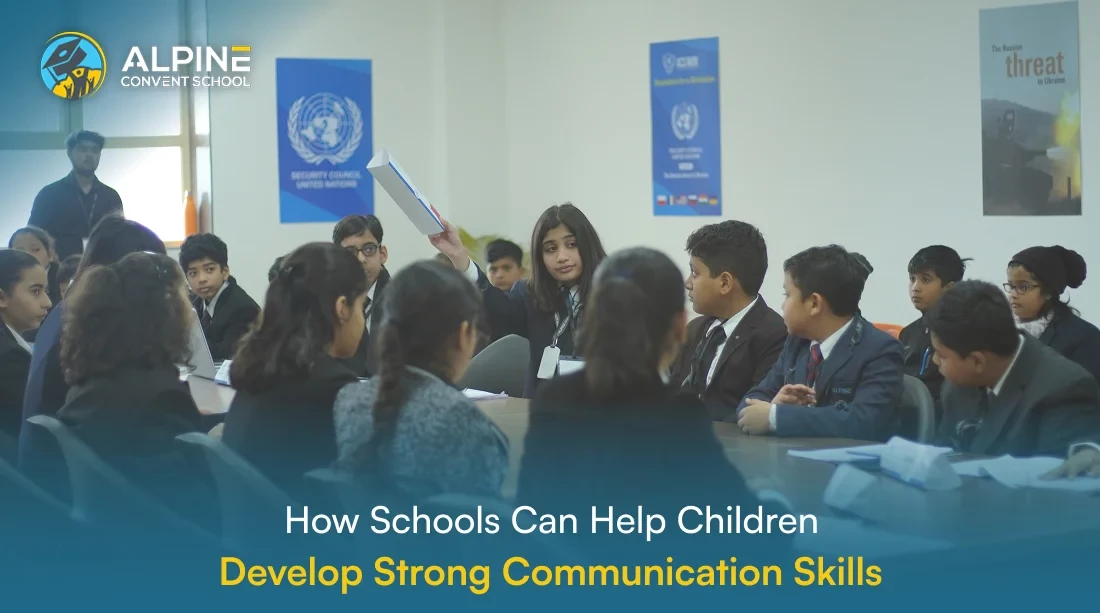
Older students need structured chances to argue, persuade and collaborate. Debates, theatre, Model United Nations and group projects all build these skills. Alpine's website highlights Model United Nations, role plays of past leaders and collaborative learning as part of school life, alongside a dedicated music and theatre programme.
Many parents notice similar challenges. Here is how a supportive school can respond:
If a child's speech or understanding seems well behind peers, parents should speak with a paediatrician or a speech and language professional. Schools can support, but early specialist advice helps.
Lists of the best schools in Gurgaon rarely tell you how communication is taught. A campus visit does. Watch and ask about:
Many good schools in Gurgaon offer similar facilities. The difference often shows in how teachers speak to children and how much they let children speak back.
School and home work best together. A few habits help:
Strong communicators are made through practice, patience, and the right environment. The school you choose shapes how often your child gets to speak, listen, and be heard.
The best way to judge is to see a classroom in action. You can schedule a campus visit at Alpine Convent School, explore its Montessori programme, or start your application. For admission queries, call +91 9999 700 821 or email enquiry@alpineconventschool.com. Campuses are in Sector 10, Sector 38, Sector 56, Sector 67, and Sushant Lok-1 (Sector 28), Gurugram.
16 October, 2026
15 October, 2026
14 October, 2026